
back in 2018 I think it was, we came up with the perfect entertainment for our booth at the jeeconf conference
the game was called code golf and the rules were very simple: write the smallest program (to make counting easier, we agree that spaces/newlines don’t count) that prints the following text:
JDK 1.0 was released in January 1996
JDK 1.1 was released in February 1997
JDK 1.2 was released in December 1998
...
JDK 41 will be released in September 2033
JDK 42 will be released in March 2034
there were about thirty participants and three of them later came to work with us, an astronomical 10% conversion compared to the usual conference entertainment
Try it yourself
of course in 2026 nobody is going to write code by hand, so drop this prompt to your favourite agent:
read the code golf task described in github gist
yermilov/a764a182d63e0fa261104064ca6ff0e3
try to solve it. do no harm, just write and run the code
the full rules and all 43 lines of the target are in that same gist. the first thing the agent will ask you is how exactly to approach this
A model is not a point, it is a range
every modern model has an effort dial - how many tokens it is allowed to burn on one answer, from low to max. anthropic’s docs say it plainly: tuning effort is often a better lever than switching models, and on fable 5 even low effort often beats xhigh on previous models. so a model is not a point on a scale, it is a range, and the ranges of neighbouring models overlap
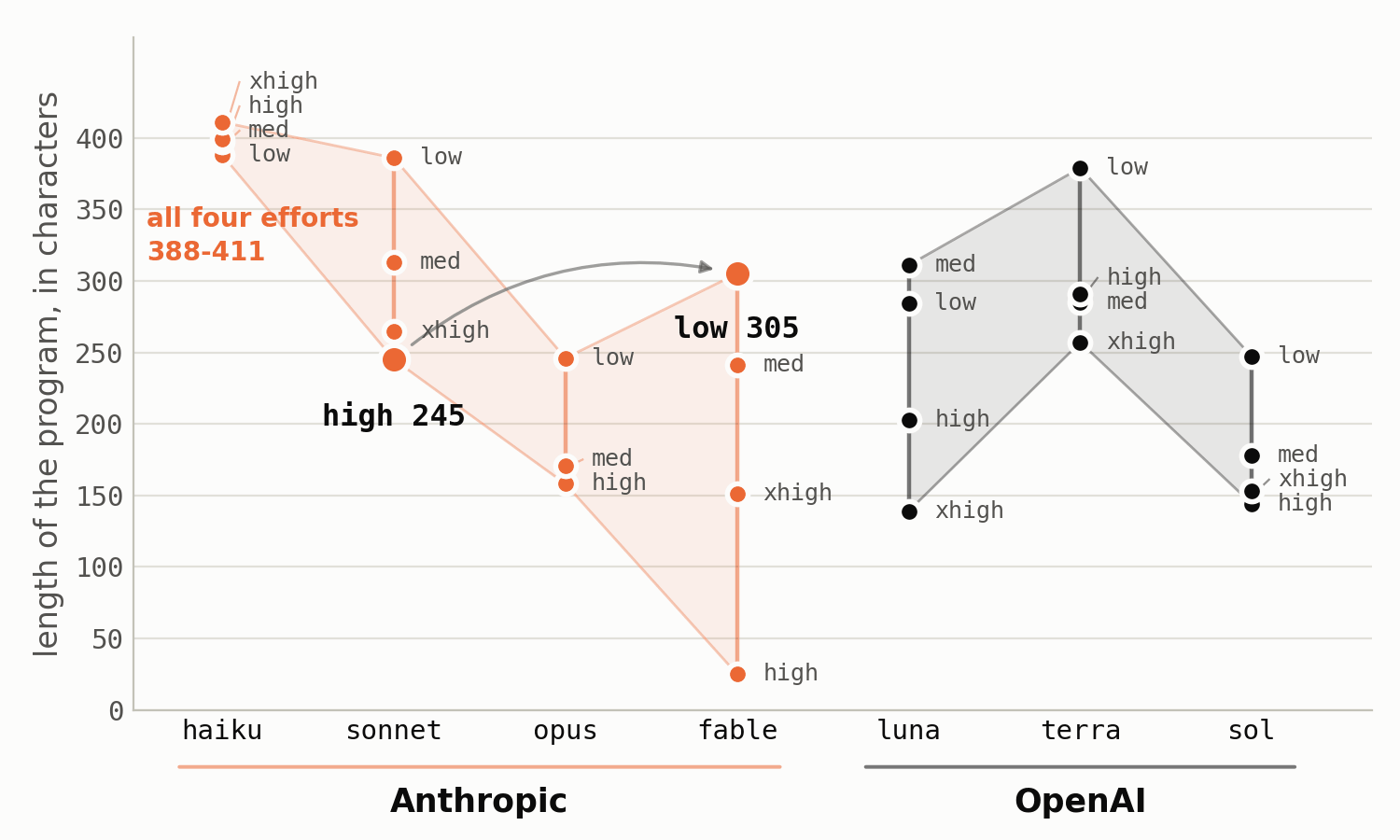
in my runs sonnet at high gave 245 characters, and fable at low - 305: the smaller model at full throttle beat the bigger one idling. but a range has a ceiling - haiku across all four efforts stayed between 388 and 411 and never went lower. where effort hits the ceiling, the docs advise one thing: change the model
Two techniques
in the real world of course nobody hands a model a task and expects the right solution straight away. write down the two simplest and most effective techniques
first: research before you write
before you write any code, research the techniques that make a program
like this shorter. only then implement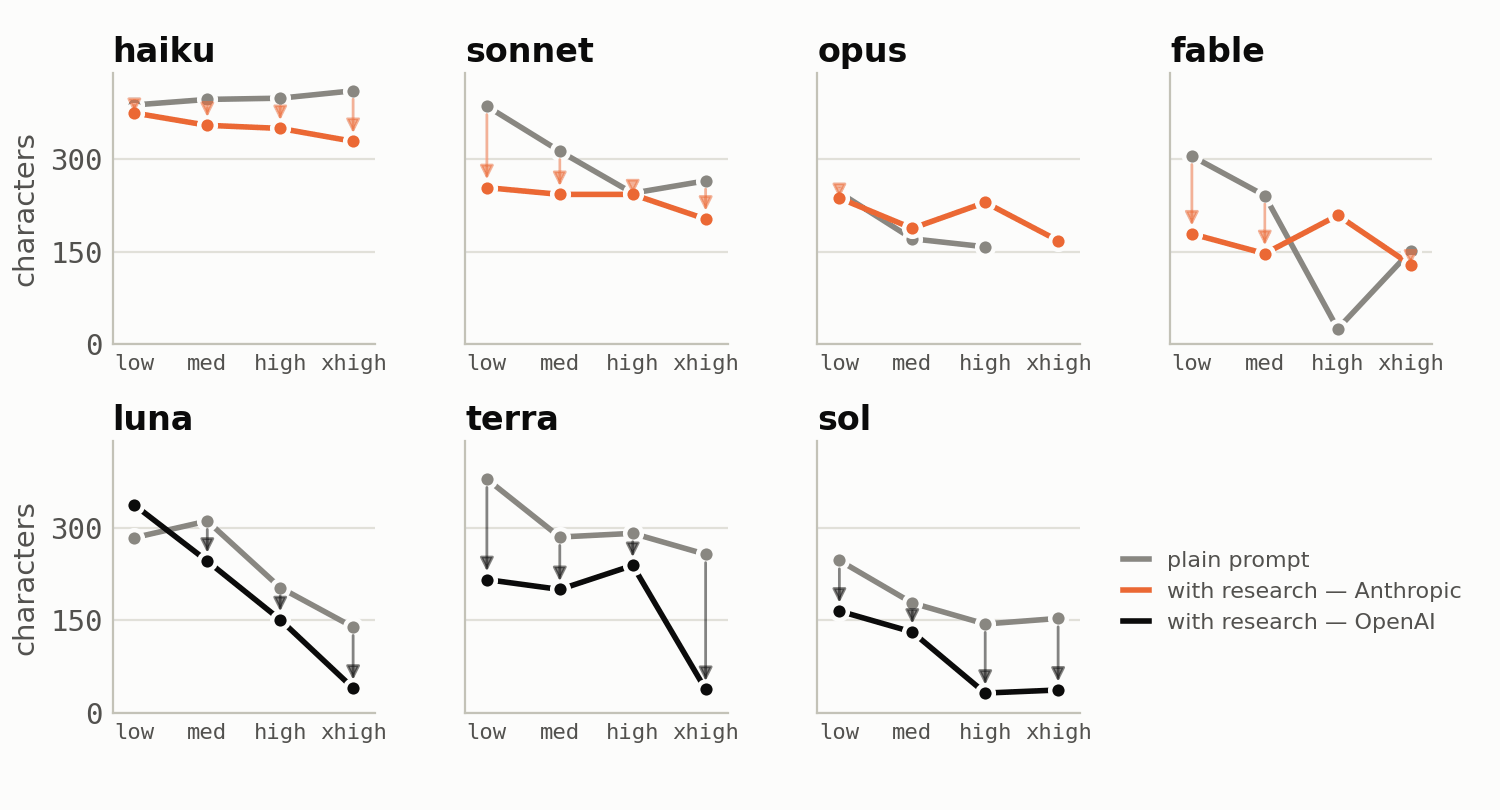
second: iterate and validate
keep shrinking it until you run out of ideas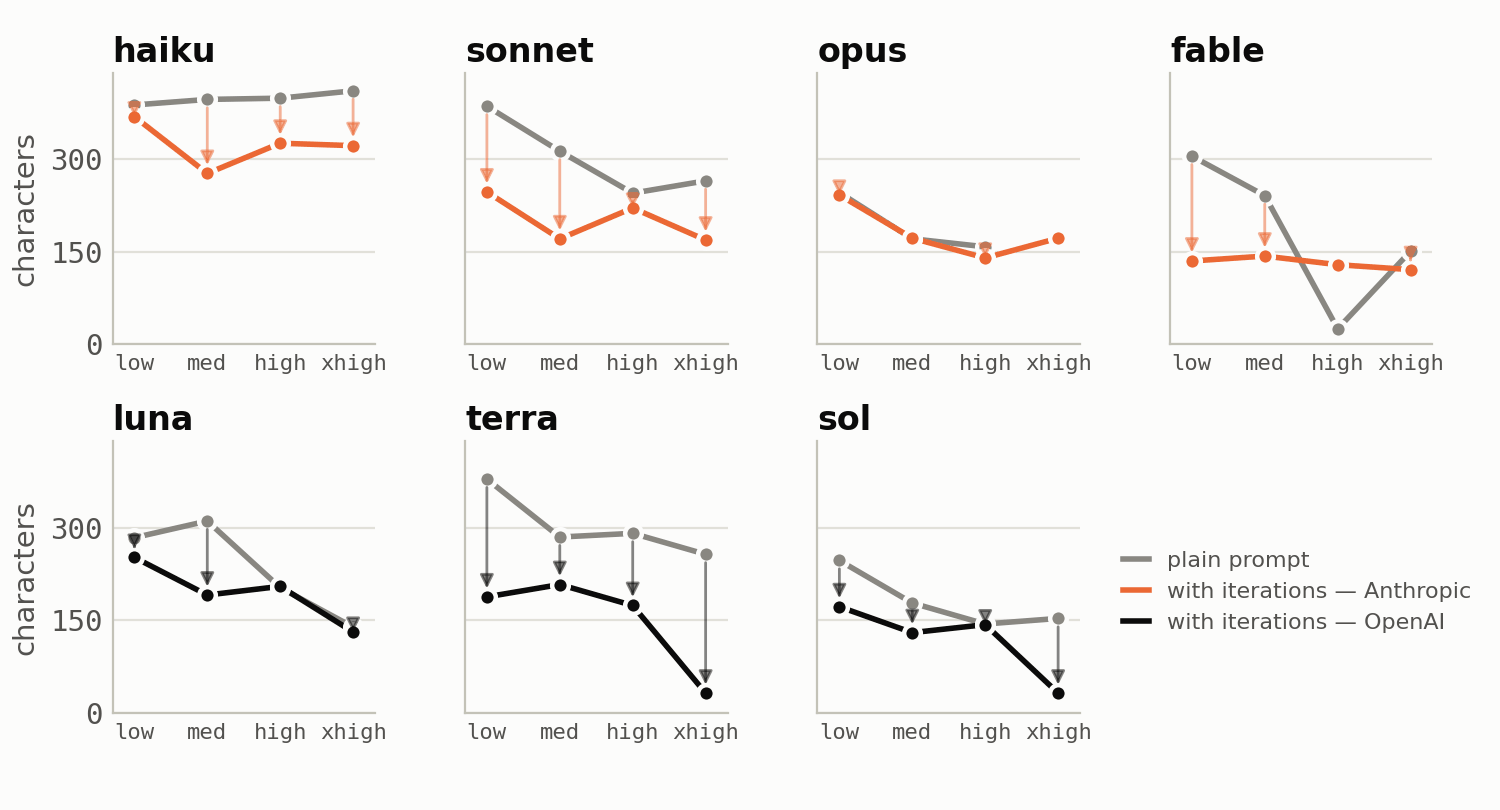
a model on a weaker effort almost always beats itself on a stronger one one-shot. the median gain is 30%, that’s 89 characters
The shortest one I have seen
back in 2018 when we gave this task to live humans at the conference, two participants caught us on the whitespace rule and encoded the text to be printed with it. the shortest one I have seen looks like this:
"<131 756 spaces and 1 672 tabs>".scan(/ +/){putc$&.size}by now four models out of seven have figured this out. fable did it best - one-shot, without any hint, on the first try. the other three are all the gpt-5.6 family, but only if you ask them at xhigh to research the topic first or to iterate
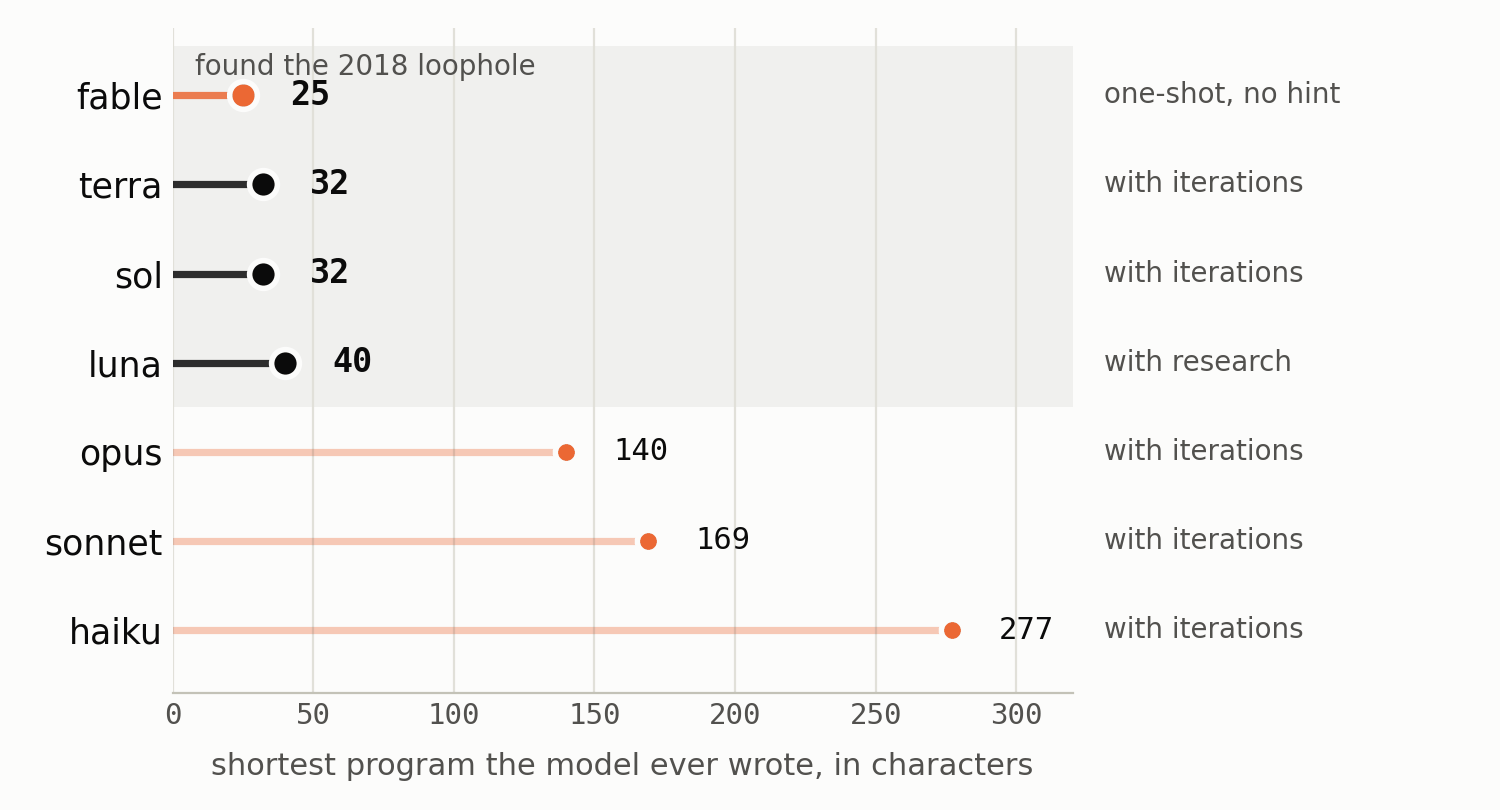
in 2018 two out of thirty found it. in 2026 - four out of seven